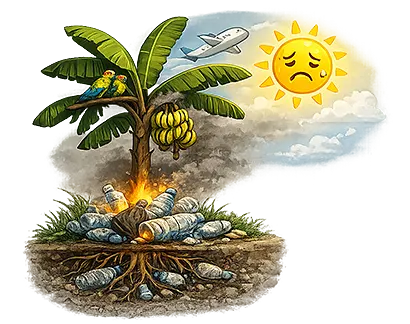
Economic & Tourism Impact
Plastic burning and illegal dumping don’t just harm your health – they
also hurt Sri Lanka’s economy and tourism.
Every illegal fire,
every pile of waste along a beach or road drives away visitors, destroys
fishing livelihoods, and lowers property values.
Economic & Tourism Impact: The Hidden Cost of Plastic Burning & Waste Dumping
🏖️ Tourism Under Threat: A Sector at Risk
Sri Lanka's tourism industry, a vital economic engine contributing approximately 7.8 percent to national GDP in 2023, is directly threatened by plastic pollution and waste burning. Tourist destinations such as Unawatuna and Mirissa frequently suffer from plastic litter, including polythene bags, straws, and food wrappers.
- Beach contamination: A scientific study examining four Sri Lankan beaches (Kallady, Negombo, Kandakuliya, and Balapitiya) found that plastic items constituted 51% of all litter, with Kallady Beach classified as "extremely dirty" and all sites rated as having a "bad" environmental status
- Visitor dissatisfaction: SUP-related pollution can lead to tourist dissatisfaction with beach cleanliness, which may result in a decline in visitor numbers, job losses, and reduced foreign exchange earnings
- Destination degradation: In Ella, a highland town popular with tourists, the daily influx of over 1,000 visitors during peak seasons generates 1 to 5 kilograms of solid waste per person, with informal dumping along railway tracks and forest edges being common
🐟 Fisheries & Coastal Livelihoods: Communities Devastated
The fishing industry, which accounts for roughly 2 percent of Sri Lanka's GDP, has suffered severe losses due to plastic pollution and environmental disasters.
- X-Press Pearl disaster: Following the 2021 container ship fire, nurdle pollution triggered months-long fishing bans, devastating household incomes and forcing an estimated 20,000 families to abandon the industry
- Marine ecosystem damage: Floating plastics damage coral reefs, which serve as vital fish breeding grounds. Microplastics have been detected in locally consumed marine fish species, raising concerns about food safety and public health
- Coastal community waste crisis: A study in Mannar District revealed that among waste disposal methods, illegal dumping (24.1%) and burning (17.9%) were the most prevalent, with 444 ± 17 kg of PET bottles recovered from 24 fishery sites per month
🏠 Property Values & Urban Inequities
Open waste dumping directly impacts property values and exacerbates social inequalities.
- Property devaluation: A scientific study in Colombo found that property values increase by 10% for every additional 100 meters of distance from an open dumpsite
- Exacerbating inequities: As open dumpsites are often sited in less affluent areas, such sites are likely exacerbating urban inequities in urban agglomerations
💸 Direct Economic Losses & Missed Opportunities
The failure to implement proper waste management systems comes with staggering economic costs.
- EPR non-implementation: Sri Lanka has lost an estimated US$ 500 million due to the non-implementation of Extended Producer Responsibility (EPR) mechanisms for plastic waste management
- Unmanaged waste: An estimated 171,561 tonnes or around 69% of Sri Lanka's annual plastic waste remains unmanaged, representing lost value that could be recovered through recycling and circular economy initiatives
- Healthcare costs: Pollution-related diseases impose significant burdens on Sri Lanka's healthcare system and household budgets
🌾 Agriculture & Food Security
Environmental degradation from waste burning and dumping threatens agricultural productivity.
- Soil contamination: Toxic residues from plastic burning contaminate agricultural soils, reducing crop yields and threatening food security
- Water pollution: Contaminated irrigation water affects crop quality and poses risks to livestock
- Long-term productivity loss: The Asian Development Bank warns that widespread degradation of coastal and agricultural resources due to environmental pressures could cost the economy more than 6% of GDP by the end of this century
🔄 The Circular Economy Opportunity
Despite these challenges, Sri Lanka has significant opportunities to transform waste into economic value.
- Recycling potential: By embracing bottle-to-bottle recycling, Sri Lanka can transform waste into worth for the economy, communities, and future generations
- Job creation: Proper waste management and recycling systems could create thousands of formal sector jobs
- Community willingness: The Mannar District study revealed strong community willingness to participate in structured waste management solutions